← Home · Slopes & Walls

Slope Stability Analysis in Aylesbury: Geotechnical Design for the Vale Landscape

Together, we solve the challenges of tomorrow.

DETAILS →

Aylesbury's expansion from a Saxon market town into a growing Buckinghamshire commuter hub has pushed new housing and infrastructure onto the surrounding Vale slopes. The geology here rarely forgives assumptions: the Lower Greensand Formation and the stiff but weathered Gault Clay create a layered subsurface where shallow failures can develop after prolonged rainfall. Our team has worked on cuttings along the A41 and residential earthworks near Fairford Leys, where test pits helped map the interface between fill and natural clay before any stability model was built. A slope stability analysis in this setting must reconcile BS EN 1997-1:2004 with the real drainage conditions observed in winter, because pore pressure response in the Aylesbury clay can reduce the factor of safety faster than standard parameters predict.

In Aylesbury's layered Greensand-over-Gault terrain, pore pressure, not geometry, dictates the failure mechanism.

Approach and scope

Eurocode 7 (BS EN 1997-1:2004) Design Approach 1 Combination 2 often governs slope stability in Aylesbury, particularly where the Gault Clay exhibits its characteristic low effective friction angle of 22 to 26 degrees. We run both circular and non-circular slip searches using limit equilibrium methods (Bishop simplified and Spencer) calibrated to back-analysis of local cuttings. The groundwater regime is the decisive variable: a perched water table within the Greensand above the clay can trigger translational slides if not intercepted by drainage. For embankment slopes on the Aylesbury Arm of the Grand Union Canal, we complement the analysis with in-situ permeability tests to quantify the seepage regime before selecting reinforcement or regrading measures. Our laboratory programme runs parallel with the field investigation, measuring peak and residual strength from triaxial tests on undisturbed Shelby tube samples recovered from the slope face and toe.
Slope Stability Analysis in Aylesbury: Geotechnical Design for the Vale Landscape
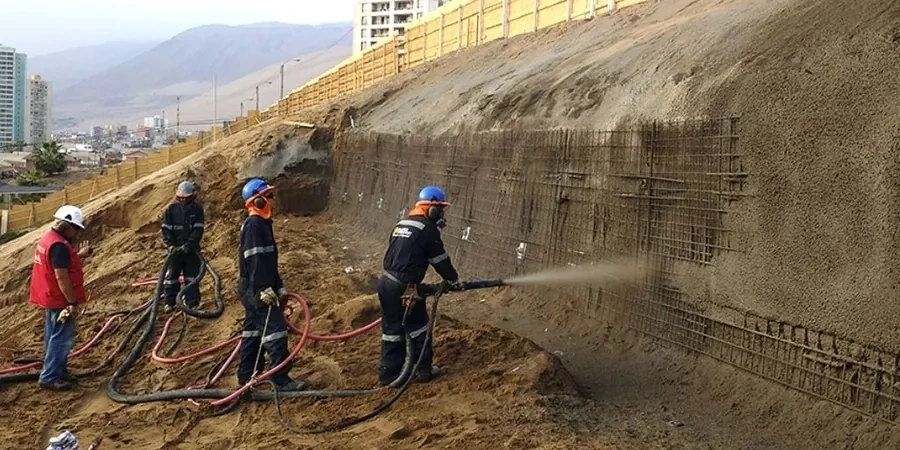
Technical reference image — Aylesbury

Site-specific factors

A 14-metre-high cutting for a residential scheme west of Aylesbury started showing tension cracks along the crest after a wet December, just weeks before foundation works. The original design had assumed fully drained conditions, but a perched water layer in the weathered Greensand had not been intercepted by the drainage specified on paper. We mobilised within 48 hours, installed standpipe piezometers, and recalibrated the slope stability analysis with the measured pore pressures. The factor of safety had dropped to 0.98. The solution combined regrading the upper bench, installing counterfort drains drilled horizontally from the face, and adding a toe berm keyed into the Gault. The lesson from this site and others across the Vale is that Aylesbury slopes demand drainage redundancy; a single underdrain line is not enough when the hydraulic conductivity of the Greensand can exceed 10⁻⁵ m/s and feed water into the cut face during prolonged rainfall.

Need a geotechnical assessment?

Reply within 24h.

Email: contact@geotechnical-engineering1.com

Service video


Technical parameters

ParameterTypical value
Analysis methodLimit equilibrium (Bishop, Spencer, Morgenstern-Price); FE stress-based (Plaxis 2D)
Design standardBS EN 1997-1:2004 + UK National Annex; BS 5930:2015 for ground investigation
Material strength inputEffective stress parameters (c', φ') from CIU triaxial and direct shear; residual φ'r for pre-existing shears
Groundwater modellingSteady-state phreatic surface, perched layers, and transient drawdown scenarios per CIRIA C750
Seismic coefficientkh = 0.05–0.10 per UK seismic hazard (BS EN 1998-5 Annex E)
Target factor of safetyFoS ≥ 1.30 permanent, ≥ 1.10 temporary (cut slopes during construction)
Output deliverablesCritical slip circle plots, reinforcement force envelopes, drainage design recommendations, monitoring trigger values

Related technical services


01

Natural slope & escarpment assessment

Stability review of existing hillsides for proposed development near the top or toe. Includes field mapping of springs and seepage, trial pitting to determine colluvium thickness, and 2D limit equilibrium analysis with sensitivity to seasonal groundwater rise. We use Spencer's method for non-circular surfaces along the Greensand-Gault contact, reporting FoS against BS EN 1997 Design Approach 1.

02

Cut slope & earthworks design

Design of permanent and temporary cuttings for road widening, residential platforms, and commercial earthworks. We model staged excavation sequences in Plaxis 2D to capture undrained unloading in the Gault, then specify slope angles, bench widths, and drainage systems (toe drains, counterfort drains, surface water interceptor ditches) to maintain FoS ≥ 1.30 long term.

03

Remediation & forensic back-analysis

Investigation and redesign for slopes showing distress—tension cracks, bulging toes, or shallow slips. We combine inclinometer data, piezometer readings, and laboratory residual strength testing on shear surfaces to recalibrate the stability model, then design remedial works: regrading, drainage improvement, soil nailing, or toe berms as appropriate for the Aylesbury ground conditions.

Relevant standards

BS EN 1997-1:2004 Eurocode 7 — Geotechnical design — Part 1: General rules, BS 5930:2015+A1:2020 Code of practice for ground investigations, CIRIA C750 — Groundwater control: design and practice, BS EN 1998-5:2004 Eurocode 8 — Design of structures for earthquake resistance — Part 5: Foundations, retaining structures and geotechnical aspects

Q&A


How much does a slope stability analysis cost for a typical residential development site in Aylesbury?

For a single slope cross-section with ground investigation data available, the analysis typically ranges from £890 for a preliminary 2D limit equilibrium assessment to £3,160 for a fully documented Plaxis FE model with multiple groundwater scenarios and reinforcement design. The final fee depends on the number of critical sections, the availability of site-specific lab strength data, and whether back-analysis of an existing failure is required.

What ground investigation is needed before a slope stability analysis can be carried out?

At minimum, we need boreholes with undisturbed sampling at the crest, mid-slope, and toe, plus standpipe or vibrating-wire piezometers to establish the groundwater profile. In Aylesbury, where the Greensand-Gault contact controls many failures, we recommend at least one borehole penetrating 3 to 5 metres into the Gault Clay. Laboratory testing must include CIU triaxial or multistage direct shear to define effective stress parameters, plus Atterberg limits and moisture content profiles. If pre-existing shear surfaces are suspected, we run ring shear tests for residual strength.

Do you handle slopes with existing vegetation and tree root influence?

Yes. Tree-root reinforcement can add apparent cohesion to the near-surface soil, but root decay or removal for development can eliminate that benefit. We account for vegetation effects in the analysis by adjusting the cohesion envelope in the upper 1.5 to 2.0 metres based on root architecture and species. In Aylesbury, where mature oak and ash are common on escarpment slopes, we also assess the long-term suction regime from evapotranspiration, which can provide a seasonal boost to FoS that should not be relied upon in the permanent case.
Location and service area

We serve projects across Aylesbury and its metropolitan area.

View larger map
/body>