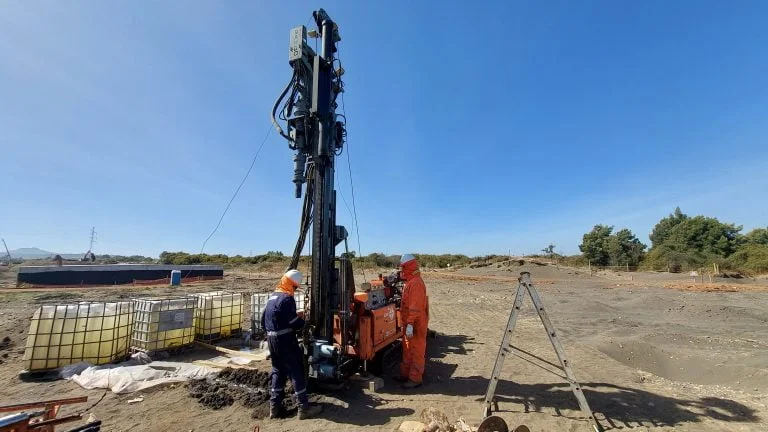
A recent ground investigation off Bicester Road turned up a metre of Victorian backfill nobody expected. Just below it, the chalk was riddled with solution features that a borehole alone would have missed. That is exactly why exploratory test pit work matters here. Aylesbury sits on a transition zone — Gault clay to the north, weathered chalk of the Grey Subgroup to the south, and pockets of alluvium along the Bear Brook corridor. Opening a test pit gives you direct sight of these contacts. Samples get logged to BS 5930, photographed, and mapped before the excavation is backfilled. For foundation verification, service trench assessment, or checking old fill thickness, nothing replaces seeing the ground with your own eyes.
A single test pit can reveal more about fill history and shallow variability than three boreholes drilled blind.
Approach and scope
Contractors in the Vale often assume the chalk is competent from the surface, but we have seen putty chalk within the first two metres on sites near the canal. That changes bearing capacity estimates overnight. Our exploratory test pit process starts with a CAT scan to clear buried services, then mechanical excavation down to 4.5 metres or refusal. In situ strength is recorded with a hand vane and pocket penetrometer at each change of strata. Disturbed and undisturbed samples go to the lab for moisture content and classification. If the pit wall holds, we log joints, infill, and seepage directly. Backfill is compacted in lifts once the engineer signs off the log — leaving the site safe and tidy. For deeper profiling into the chalk, the team often pairs a pit with a dynamic probe or lightweight CPT to extend the depth of investigation without bringing in a full rig.
Local ground factors
Aylesbury has a population of over 80,000 and continues to expand with major housing allocations. Much of that new development sits on former agricultural land where backfilled ponds, old drainage lines, and buried topsoil create soft spots that standard window sampling can miss. Missing a metre of compressible fill beneath a footing means differential settlement, cracked masonry, and a costly claim. The risk is particularly acute near the Bear Brook floodplain, where organic silts can be masked by a crust of stiffer material. An exploratory test pit cuts through that crust and exposes what is really there. Building Control increasingly asks for photographic pit logs when site history is unclear. Getting that evidence early keeps the programme on track and avoids last-minute redesign.
Q&A
How much does an exploratory test pit cost in Aylesbury?
The typical budget for a single pit, including machine, operator, engineer log and backfill, falls between £420 and £700. The spread depends on depth, access width, whether a trench box is needed, and the number of samples sent to the lab. VAT is additional.
Do I need a permit to open a test pit on my site?
Private land generally does not require a permit, but you must follow CDM 2015 for safety. If the pit is within the public highway or a Conservation Area — for example near St Mary's Church — you will need a street works licence and possibly an archaeological watching brief.
Can a test pit replace a borehole for my house extension?
In shallow chalk or clay sites around Aylesbury, a pit often gives Building Control enough confidence on bearing stratum, especially when combined with a hand vane reading. If the load is heavy or the ground variable, we recommend supplementing the pit with a lightweight dynamic probe to check deeper layers.
How long does the pit stay open and is it safe?
Most single pits are logged, sampled and backfilled within the same working day. Deeper pits over 1.2 metres are either battered back or protected with a trench box. The area is fenced and signed, and the engineer is present throughout to manage the excavation safely.