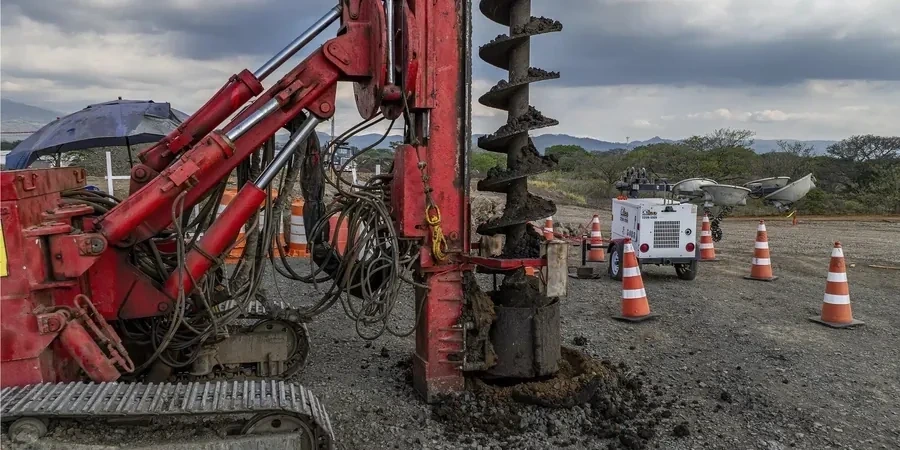
Aylesbury sits at roughly 80 metres above sea level on the northern edge of the Chiltern Hills, where the underlying geology shifts from chalk to the softer clays of the Vale of Aylesbury. Across the expanding housing estates surrounding the town, from Berryfields to Kingsbrook, weak alluvial deposits and compressible Kimmeridge Clay create poor bearing conditions that rule out conventional shallow foundations. Stone column design resolves this by forming stiff, gravel-reinforced inclusions that densify the ground and accelerate consolidation—transforming marginal plots into buildable land. For sites where granular fill extends deeper than six metres, we often combine the column layout with a CPT test to verify tip resistance through the treated zone and confirm that design assumptions hold before piling rigs move off site.
A well-designed stone column layout can reduce settlement by 60–70% compared to untreated ground, turning six metres of soft clay into a competent bearing stratum.
Local ground factors
The contrast between the chalky head deposits near Bierton and the deep alluvium south of the River Thame illustrates the risk of uniform foundation specifications across Aylesbury. On the south side, soft clays extend beyond eight metres, and stone columns that terminate too early within the compressible zone can punch through, causing differential settlement under floor slabs. Conversely, over-consolidated clay with sand lenses north of the town centre may drain rapidly enough during vibration that pore pressure build-up is negligible, but densification still varies laterally. The design must account for this variability: column length, stone volume per metre, and vibrator power are adjusted block by block. A single set of parameters copied across the site without referencing the ground investigation logs risks serviceability failures that are expensive to rectify once superstructure framing has started.
Q&A
What ground conditions in Aylesbury make stone columns a good choice?
Soft, compressible clays of the Kimmeridge formation and alluvial silts in the Vale of Aylesbury typically have undrained shear strengths below 40 kPa. Stone columns are effective in these conditions because they densify the soil radially and create stiff composite ground that supports shallow footings, avoiding the higher cost of deep piling.
What does stone column design cost for a typical Aylesbury residential plot?
For a single residential plot in Aylesbury, the design package—including layout, settlement analysis, and installation specification—generally falls between £1.270 and £3.710, depending on the number of columns and the complexity of the ground investigation data that needs to be interpreted.
How do you verify that the installed columns meet the design intent?
We specify post-treatment CPTs at column centres and midpoints to confirm the increase in tip resistance relative to pre-treatment values. For critical floor slabs, plate load tests per BS 1377 or zone load tests on individual columns provide direct load-settlement curves that validate the composite modulus used in the settlement analysis.