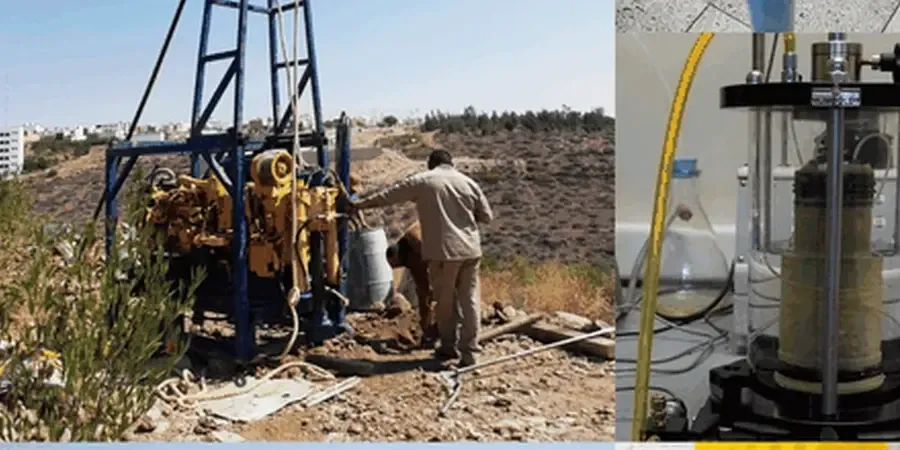
Ground improvement in Aylesbury encompasses a range of geotechnical techniques designed to enhance the engineering properties of soils, ensuring stability, reducing settlement, and increasing bearing capacity for construction projects. In a town experiencing steady residential and commercial growth, the demand for reliable foundation solutions has never been greater. The local geology, characterised by complex sequences of Gault Clay, Lower Greensand, and alluvial deposits along the River Thame, often presents challenges such as low-strength cohesive soils and variable groundwater conditions. Without adequate ground treatment, developments risk differential settlement, structural damage, and costly delays. This category covers design-led approaches that transform poor ground into competent strata, enabling safe and economical construction across Aylesbury's expanding urban landscape.
The geological setting of Aylesbury directly influences the choice of improvement methods. Much of the town sits on the Gault Formation, a stiff but sometimes compressible clay prone to shrinkage and swelling with seasonal moisture changes. Overlying this are superficial deposits of alluvium and river terrace gravels, particularly in the floodplain areas near the town centre and along the Thame Valley. These softer, water-bearing sediments require careful assessment to determine their load-bearing potential. Ground improvement becomes essential when weak or variable soils are encountered at shallow depths, as traditional shallow foundations may not suffice. Techniques such as stone column design provide vertical reinforcement through weak cohesive soils, accelerating consolidation and improving drainage, while vibrocompaction design densifies loose granular deposits, increasing relative density and reducing the risk of liquefaction or excessive settlement.
All ground improvement works in the United Kingdom must comply with the relevant national standards and regulations. The primary framework is Eurocode 7 (BS EN 1997), which governs geotechnical design and requires a limit-state approach to ensure safety and serviceability. Part 1 provides general rules, while Part 2 addresses ground investigation and testing. These are supported by the UK National Annexes, which specify nationally determined parameters. Additionally, BS 8004:2015 offers guidance on the design of foundations and ground improvement, and BS 5930:2015+A1:2020 sets out the code of practice for site investigations. For vibro-stone column techniques, the ICE Specification for Ground Treatment and the BRE Digest 433 provide detailed recommendations. Adherence to these standards is not optional; they form the basis for regulatory approval through building control and are often mandated by warranty providers such as NHBC for residential developments.
The types of projects in Aylesbury that require ground improvement are diverse, spanning from large-scale housing estates on greenfield sites to urban infill developments on previously disturbed ground. The Aylesbury Vale area has seen significant allocation of land for new homes under the Vale of Aylesbury Local Plan, much of it on former agricultural land underlain by clay or alluvium. Commercial and industrial units, particularly in zones like the Gatehouse Road and Broadfields trading estates, often demand heavily loaded floor slabs and crane bases that necessitate improved ground. Infrastructure projects, including road widening schemes and flood alleviation works along the Bear Brook, also rely on these techniques to stabilise embankments and foundations. In each case, early engagement with a specialist designer ensures the most appropriate and cost-effective solution is selected based on detailed site investigation data.
Ground improvement refers to a set of geotechnical techniques used to modify the physical properties of soil in situ, increasing its strength, stiffness, and drainage capacity. In Aylesbury, it becomes necessary when site investigations reveal weak or compressible soils—such as the alluvial clays and silts found in the Thame Valley—that cannot safely support proposed loads without excessive settlement, requiring treatment to meet Eurocode 7 serviceability limits.
Ground improvement design in the UK is primarily governed by Eurocode 7 (BS EN 1997-1 and 1997-2) and its National Annexes, which establish limit-state design principles. Supplementary guidance is provided by BS 8004:2015 for foundation design, BS 5930 for site investigation, and the ICE Specification for Ground Treatment. Compliance with these standards is essential for building control approval and warranty acceptance.
The choice depends on the soil profile, loading requirements, and project constraints. A thorough ground investigation is the first step, identifying soil types, strength parameters, and groundwater conditions. For soft cohesive soils, stone columns may be optimal to accelerate consolidation; for loose granular deposits, vibrocompaction can achieve rapid densification. A specialist designer will evaluate these factors against Eurocode 7 performance criteria to recommend the most suitable technique.
Ground improvement often offers significant advantages over deep piling, including reduced programme time, lower carbon footprint, and cost efficiency—particularly for large-area treatments. It treats the ground mass directly, creating a uniform bearing stratum that supports conventional shallow foundations. This approach also minimises off-site disposal of spoil and avoids the need for extensive piling mats, making it a sustainable choice for many Aylesbury developments.