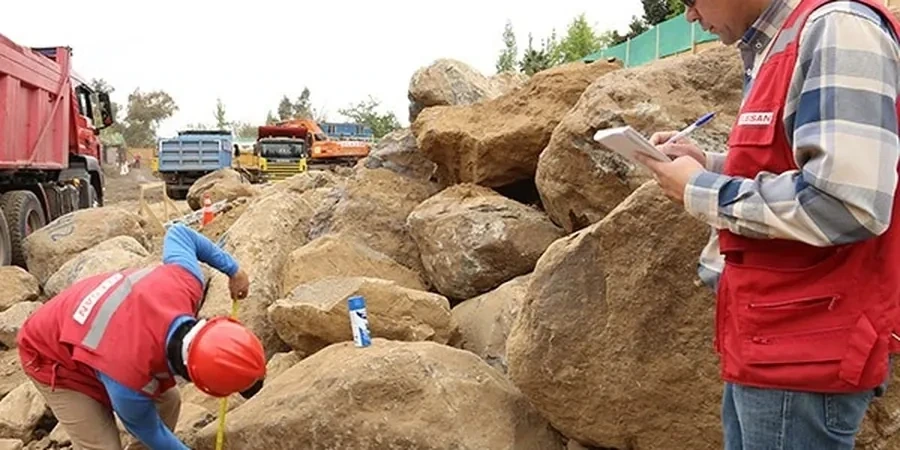
In Aylesbury, we often see foundation designs that underestimate just how much the ground can change across a single site. The town sits on a mix of Gault Clay, Upper Greensand, and chalk of the Grey Chalk Subgroup, and the transition zones between these units are rarely as clean as the geological maps suggest. A desktop study alone won't tell you how stiff the clay actually is at 3 metres depth, or whether solution features in the chalk pose a real risk beneath your footing line. That's where a properly scoped soil mechanics study comes in. Our lab, accredited to ISO 17025, runs the full suite of classification and strength tests—from moisture content and Atterberg limits through to effective-stress triaxial—so the ground model you feed into your Eurocode 7 design is based on measured parameters, not conservative assumptions lifted from a textbook. When we're on the rotary rig south of the A41, we're not just logging strata; we're building a picture of how the ground will actually behave under load, which is especially critical in areas where the chalk cover thins and the Gault Formation introduces medium-plasticity clays into the bearing stratum.
In Aylesbury, the biggest risk isn't the clay or the chalk—it's the transition zone between them, where stiffness can halve in less than a metre.
Local ground factors
The mistake we see repeatedly in the Aylesbury area is treating the chalk as uniform rock and the Gault Clay as a uniform soft soil, then designing foundations on a single borehole log. Chalk in the Grey Subgroup can contain dissolution pipes and clay-infilled hollows that extend several metres below the surrounding surface of the chalk, and a borehole that misses these features by a metre will give a completely misleading picture of bearing conditions. On the clay side, the Gault Formation is heavily overconsolidated but can soften significantly in the upper 2–3 metres due to weathering, and if you base your allowable bearing pressure on a sample taken at 5 metres depth, you'll be too optimistic for the weathered crust. A soil mechanics study that includes careful logging of chalk structure, point load testing on intact cores, and moisture content profiles through the weathered zone eliminates this guesswork. When we combine that lab data with in-situ SPT N-values or CPT tip resistance, the ground model becomes solid enough to justify either a shallow foundation on stiff clay or a deeper solution bearing on Grade II chalk.
Q&A
How much does a soil mechanics study cost for a typical project in Aylesbury?
For a single-storey extension or small residential project around Aylesbury, a targeted soil mechanics study—including classification, a couple of triaxial tests, and a short interpretive report—typically falls between £2,200 and £4,590, depending on the number of strata encountered and whether chalk cores need UCS testing. Larger multi-borehole investigations with consolidation testing and chemical analysis will sit at the upper end or beyond.
What laboratory tests are essential when building on Gault Clay in Aylesbury?
At minimum, you need Atterberg limits to confirm the plasticity of the Gault, moisture content profiles to assess the depth of weathering and softening, and consolidated-undrained triaxial tests with pore pressure measurement so the engineer can work with effective-stress parameters. If the clay is near a slope or adjacent to a watercourse like the Thame, we'd add ring shear or reversal direct shear for residual strength.
How do you deal with the variability of chalk in the Aylesbury area?
We log chalk grade (per CIRIA C574) on every core run, run unconfined compressive strength tests to quantify intact strength, and measure fracture spacing and infill. If dissolution features are suspected—common where the chalk subcrops beneath thin Head deposits—we may recommend a probing programme or geophysical survey to map the rockhead profile before finalising the foundation depth.