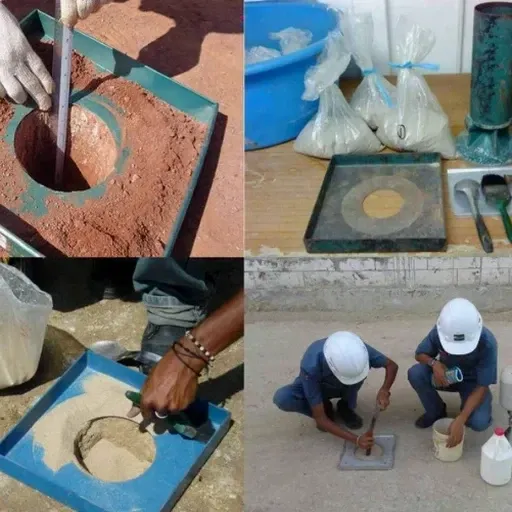
Last spring we were called to a commercial plot off the A41 where a contractor had been struggling with inconsistent compaction results on a clayey gravel formation. The earthworks contractor was running plate load tests, but the client’s engineer demanded direct density control on every 300 mm lift of the structural fill beneath a proposed warehouse slab. This is exactly where the sand cone density test earns its keep in Aylesbury’s variable geology—it gives you a direct, traceable measurement of in-place dry density, not an inferred stiffness value. We set up three test locations across the pad, carefully excavating the test holes with a density spoon and a small chisel to avoid disturbing the surrounding material. The backfill on that job was a locally sourced sandy silt from a pit near Stone, and the lab ran parallel Proctor tests to establish the reference maximum dry density. Over two days we completed twelve sand cone tests, and the compaction curve for that material turned out to be surprisingly sensitive to moisture content—something the contractor hadn’t appreciated until the lab data came back. That’s the kind of feedback that prevents a failed re-inspection and keeps the programme on track.
Direct density measurement with a calibrated sand cone gives you a legally defensible result—no calibration curves, no radiation safety paperwork, just mass and volume.
Local ground factors
Clause 5.2 of Eurocode 7 (BS EN 1997-1:2004) makes it clear that sufficient density testing is required to confirm the design assumptions about soil stiffness are actually achieved in the compacted fill. In Aylesbury, skipping or under-sampling density control on a clayey formation can mask softening of the upper lift after a rainy week—something we’ve seen firsthand on a housing site near the canal where the contractor had to strip and re-compact 400 mm of fill because density readings fell to 89% after water pooled on the subgrade. The sand cone method gives you a direct result that can be checked against the lab Proctor data, but it requires a technician who knows how to excavate the hole without smearing the sides, how to handle the sand column without vibration, and how to bag the sample cleanly for moisture content. In sandy gravels common on the higher ground east of Aylesbury, the test is fast and repeatable; in stiffer clays you need patience and a good density spoon. The risk isn’t the test itself—it’s running too few of them and assuming the whole pad is uniform. A single low reading can flag a systematic issue with the roller type, lift thickness, or moisture conditioning, and catching it early saves the cost of full-depth reconstruction.
Q&A
How much does a sand cone density test cost in Aylesbury?
For sites around Aylesbury, a single sand cone test typically falls between £70 and £120 depending on the number of tests per visit and the distance from our lab. A half-day attendance with six to eight tests provides the best value for most earthworks projects.
How does the sand cone method compare to a nuclear density gauge?
The sand cone gives a direct physical measurement of density—you excavate the hole, measure its volume with calibrated sand, and weigh the removed soil. There’s no nuclear source, no radiation safety officer required, and no calibration curve that can drift. On the downside it’s slower than a nuclear gauge and you can’t run it in very wet or collapsing soils, but the result is accepted by every adopting authority in Buckinghamshire without question.
How many tests do I need per lift?
The Specification for Highway Works (Series 600) recommends a minimum of one test per 300 square metres per compacted lift for general earthworks. For smaller pads or foundation trenches, we normally specify a minimum of three tests per lift to get a meaningful spread, especially on Aylesbury’s variable clay formations where density can change noticeably across a single pad.
Can the sand cone test be used on coarse granular fill?
It can, with care. For fills containing gravel larger than about 20 mm, we use a larger base plate and a bigger test hole to keep the result representative. If the fill contains significant cobbles, the sand cone becomes unreliable and we’ll recommend a replacement density test using a water balloon or a large-scale Proctor in the lab to adjust the reference curve.