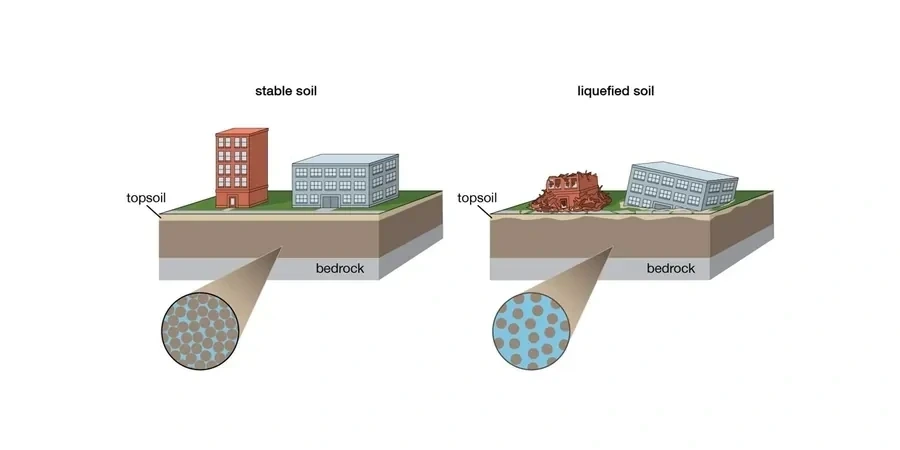
Aylesbury sits at the foot of the Chiltern Hills, straddling the clay vale and the chalk escarpment—a geological setting that masks a subtle but real seismic hazard. Most local engineers focus on the shrink-swell of the Gault Clay or solution features in the underlying chalk, yet the alluvial deposits along the River Thame present a different challenge entirely. Loose, saturated silty sands and soft silts, when subjected to even moderate ground shaking, can experience a sudden loss of strength. For critical infrastructure and multi-storey developments near the town centre, a soil liquefaction analysis is not a box-ticking exercise—it is the difference between a foundation that weathers a low-probability event and one that fails through excessive settlement or bearing capacity loss. Our approach combines in-situ penetration data with cyclic laboratory testing to quantify the factor of safety against liquefaction triggering, drawing on decades of regional ground investigation records across Buckinghamshire.
Liquefaction in Aylesbury is a low-frequency, high-consequence risk—overlooked precisely because it lies outside the UK’s highest seismicity zones, yet demonstrable in the town’s water-bearing alluvial corridors.
Local ground factors
I have seen more than one preliminary site investigation in the Aylesbury Vale dismiss liquefaction because the UK’s seismic hazard is low—and technically, the PGA values are indeed modest. The trap is the soil profile. A thin layer of loose alluvial sand at 3 metres depth, fully saturated in winter, can trigger at accelerations lower than the textbook curves suggest once you factor in basin-edge amplification off the Chiltern escarpment. The real consequence is not spectacular sand volcanoes but differential settlement that tears apart slab-on-grade floors and severs service connections. Post-liquefaction volumetric strain in silty sands can easily reach 2 to 3 percent, translating to 60 to 90 millimetres of settlement over a 3-metre layer. For a piled structure, the loss of lateral soil support and downdrag on the shaft can be the governing load case—and one that a conventional bearing capacity check will never catch.
Relevant standards
BS EN 1998-5:2004 (Eurocode 8 Part 5: Foundations, Retaining Structures, Geotechnical Aspects), BS 5930:2015+A1:2020 (Code of Practice for Ground Investigations), Boulanger & Idriss (2014) CPT and SPT Based Liquefaction Triggering Procedures, Youd et al. (2001) Summary Report, NCEER/NSF Workshops on Evaluation of Liquefaction Resistance
Q&A
Is liquefaction really a concern in Aylesbury given the UK’s low seismicity?
For most stiff clay and chalk sites, the risk is negligible. However, Aylesbury has alluvial corridors along the River Thame and its tributaries where loose saturated sands exist within 10 metres of the surface. Eurocode 8 requires a liquefaction check for all sites in ground type S2 or S3, and ignoring it can lead to costly foundation remediation later. The analysis confirms whether the risk is real for your specific site rather than assuming it is absent.
What’s the difference between a simplified SPT-based analysis and a full cyclic laboratory programme?
The simplified method uses empirical charts to estimate cyclic resistance from corrected blow counts. It is fast, cost-effective, and appropriate for most residential and commercial projects. A cyclic triaxial programme directly measures the soil’s response to earthquake loading in the laboratory and is justified for high-importance structures, deep excavations, or where the simplified method yields borderline safety factors that need refinement.
How much does a liquefaction analysis for an Aylesbury site typically cost?
A site-specific liquefaction assessment in the Aylesbury area, inclusive of field testing (SPT or MASW), interpretation, and a report with settlement estimates, generally falls between £2,180 and £3,620. The final figure depends on the number of boreholes or test points, the requirement for undisturbed sampling and cyclic laboratory testing, and the complexity of the ground profile.
Do I need a liquefaction analysis if my site is on chalk?
Intact chalk does not liquefy. However, the weathered chalk in Aylesbury—particularly the structureless grade C5/C6 putty and the overlying Lambeth Group silts—can exhibit cyclic softening. This is a different mechanism but produces similar settlement effects. A site-specific assessment clarifies whether the chalk beneath your site behaves more like a weak rock or a problematic soil under seismic loading.