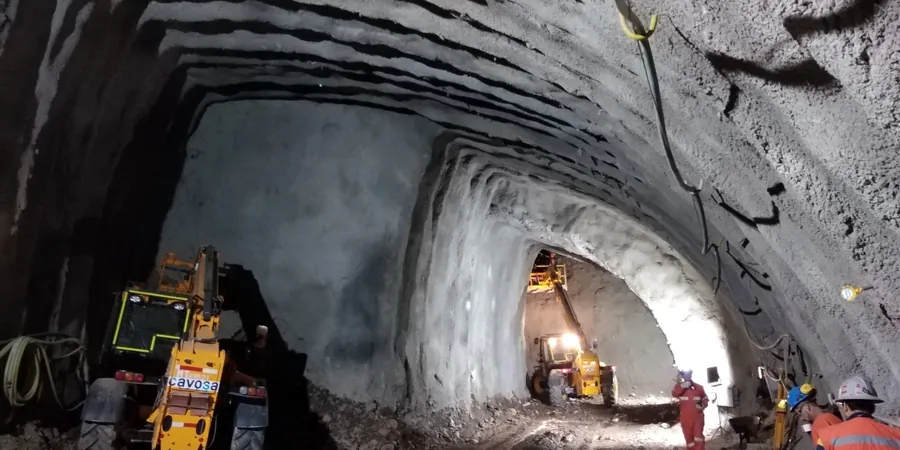
Tunnelling through Aylesbury means dealing with the Kimmeridge Clay and Lower Greensand that define the Vale's geology. BS EN 1997-2 requires a ground investigation model before any excavation, and that's where our lab steps in. We run triaxial, oedometer, and index testing to feed the design parameters for tunnel face stability and lining loads. The water table sits high across the Thame floodplain, so undrained shear strength and consolidation data drive the temporary works. We've supported schemes where soft ground conditions demanded real-time parameter updates, and our triaxial data was on the engineer's desk within five working days. For pre-construction site characterisation, combining lab results with CPT field data gives you a continuous strength profile without the gaps that borehole-only campaigns leave.
The Gault Clay in Aylesbury can lose 60% of its undrained shear strength within 48 hours of unloading. Face stability calculations must account for that drop.
Approach and scope
Aylesbury sits on Jurassic and Cretaceous strata capped by glacial till and alluvium. The Gault Clay at depth is notoriously sensitive to moisture change, and its plasticity index routinely exceeds 40% in samples we've logged from the town centre. This isn't London Clay: it's stiffer, more fissured, and the stand-up time in a tunnel face can be shorter than you'd expect. We characterise it through
Atterberg limits and consolidated-undrained triaxial paths to capture the true effective stress behaviour. Grain size distributions from the Greensand bands often show a poorly graded fine sand that's prone to running ground under hydraulic gradient. Our lab reports flag these risks with specific reference to BS 5930:2015+A1:2020 soil descriptions, so the contractor knows exactly what's ahead.
We also quantify the small-strain stiffness via bender element tests when the design calls for a hardening soil model. The oedometer modulus from incremental loading gives the one-dimensional settlement parameter, but for a tunnel in soft ground you need the full stiffness degradation curve. We deliver that in a format that plugs straight into PLAXIS or FLAC. Every sample is conditioned to the in-situ water content measured on site, and we run parallel specimens to bracket the natural variability that's typical of the Aylesbury basin.
Local ground factors
A tunnel drive under the Aylesbury town centre hit a lens of water-bearing Greensand at 8 metres depth. The face became unstable within two hours of the cutterhead stopping. The contractor had relied on a desk study assumption of continuous clay cover. Our lab received three Shelby tube samples from the transition zone that same afternoon. Consolidated-undrained triaxial tests showed a friction angle of 34° and zero cohesion at the sand horizon, which explained the rapid loss of face pressure. The temporary works designer revised the support pressure envelope based on our effective stress parameters, and the drive resumed with a 40 kPa increase in face pressure.
That job reinforced why laboratory testing must match the geological reality, not the geological assumption. In Aylesbury, the boundary between the Kimmeridge Clay and the overlying drift deposits is rarely a neat line on a borehole log. We see interbedded silts, lenses of gravel, and weathered zones that change the tunnelling behaviour metre by metre.
Q&A
How much does geotechnical laboratory testing for a soft soil tunnel project cost?
Testing programmes for tunnel projects in Aylesbury typically range from £3,680 to £12,420 depending on the number of samples, the test types required, and turnaround time. A basic suite covering index tests and a few triaxial specimens sits at the lower end. A full design package with multi-stage triaxial, oedometer, and bender element tests across multiple boreholes reaches the upper end. We provide a fixed-price quote after reviewing the ground investigation scope.
What soil types in Aylesbury are most problematic for tunnelling?
The Gault Clay is the main challenge. It's stiff but highly fissured, and its undrained strength drops quickly after excavation. The Lower Greensand can appear as a water-bearing sand lens above the clay, causing face stability problems. The alluvium along the Thame valley is soft and compressible, which affects portal design and settlement predictions.
How quickly can you deliver triaxial test results for a tunnel face stability review?
Standard consolidated-undrained triaxial tests with pore pressure measurement take five to seven working days from sample receipt. If the job is urgent and the sample is already in our lab, we can run a single-stage test and deliver the stress-strain curve and Mohr-Coulomb parameters in three working days. Multi-stage tests with bender elements require ten working days due to the saturation and consolidation phases.
Do you provide digital data compatible with PLAXIS or FLAC?
Yes. All advanced test results come with a digital data package that includes stress-strain curves, pore pressure response, and stiffness degradation data in CSV format. We also provide the input parameters for the hardening soil model and the Mohr-Coulomb model, formatted for direct import into PLAXIS 2D/3D or FLAC. The report references the specific test standard and sample depth so the designer can trace every parameter back to the ground investigation log.