← Home · Laboratory

Triaxial Testing in Aylesbury: Shear Strength Under Site-Specific Conditions

Together, we solve the challenges of tomorrow.

DETAILS →

The geotechnical profile of Aylesbury, situated on the low-lying Vale clays with the Chiltern chalk escarpment rising to the southeast, demands a nuanced approach to shear strength measurement. Seasonal saturation of the upper Jurassic clays and variable groundwater tables beneath the 58,000-inhabitant town create conditions where undrained scenarios often govern embankment and footing design. A consolidated undrained triaxial test with pore pressure measurement, run on undisturbed Shelby tube samples, provides the effective stress parameters—c' and φ'—needed to model long-term stability in these overconsolidated deposits. Because the local geology transitions from Gault into Kimmeridge Clay across the A413 bypass corridor, correlating the grain-size distribution with the stress-strain response from the triaxial cell allows the engineering team to isolate silt-rich lenses that could compromise a structure's bearing stratum beneath the water table.

A single-stage CU triaxial test on Kimmeridge Clay yields the drained strength envelope that governs long-term slope stability—an insight no index test can replicate.

Approach and scope

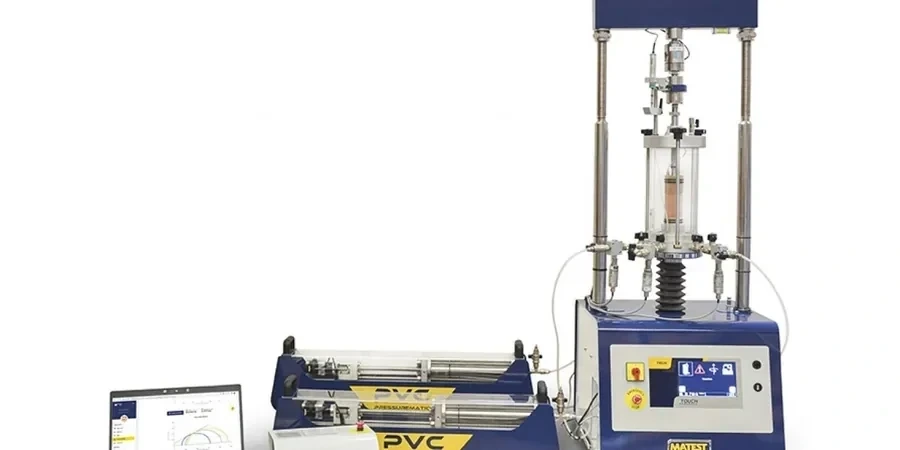
BS 1377-7:1990 governs the consolidated undrained and drained triaxial procedures applied to samples recovered from Aylesbury's more challenging sites, particularly where the weathered Gault exhibits a pronounced loss of strength upon remoulding. Each specimen is trimmed to a 100 mm diameter, saturated under a back pressure exceeding 400 kPa, and consolidated to an effective stress replicating the in-situ overburden before shearing at a controlled strain rate of 0.017 mm/min. The data acquisition system logs deviator stress, excess pore pressure, and axial strain through peak and post-peak softening, producing Mohr-Coulomb envelopes that feed directly into finite element models for deep excavations in the town centre. For heavily fissured clays where sample disturbance is unavoidable, the laboratory can also run a multi-stage triaxial test on a single specimen, a technique validated against the site-specific geological memoir published by the British Geological Survey for the Thame district.
Triaxial Testing in Aylesbury: Shear Strength Under Site-Specific Conditions
Technical reference image — Aylesbury

Site-specific factors

With Aylesbury sitting at roughly 80 m AOD and underlain by a succession of low-permeability clays, perched water tables form within the weathered zone after the sustained rainfall common to Buckinghamshire winters—averaging 650 mm annually. A site investigation that omits triaxial testing on samples from this saturated crust risks adopting a friction angle from the SPT N-value alone, an empirical correlation that the BGS itself warns against in the Ampthill Clay Formation. The consequence materialises as a rotational slip in a temporary cutting or an unplanned settlement beneath a pad footing, because the true effective strength envelope was never defined. To mitigate this, the laboratory pairs the triaxial data with Atterberg limits on the same borehole increment, ensuring that the plasticity index and liquidity index frame the measured shear strength within the expected behaviour for a high-plasticity clay of the Oxford Clay subgroup.

Need a geotechnical assessment?

Reply within 24h.

Email: contact@geotechnical-engineering1.com

Technical parameters


ParameterTypical value
Test StandardsBS 1377-7:1990, BS EN ISO 17892-8:2018, CEN ISO/TS 17892-8
Specimen Diameter38 mm, 50 mm, 70 mm, 100 mm (standard for cohesive soils)
Effective Confining Pressure Range50 kPa to 1,200 kPa, replicating depths up to approx. 60 m
Strain Rate (Undrained, CU)0.017 mm/min for 100 mm specimen (BS 1377-7 recommended)
Back Pressure SaturationMinimum 400 kPa, confirmed via B-value > 0.95
Measured Parametersc' (effective cohesion), φ' (friction angle), cu (undrained), Eu, Af
Sample StateUndisturbed (UT100), remoulded at specified density and moisture

Related technical services

01

Consolidated Undrained (CU) with Pore Pressure Measurement

The standard effective-stress triaxial test for Aylesbury clays. Three specimens are isotropically consolidated to different effective stresses and sheared undrained, with electronic transducers logging the excess pore pressure. The result is the Mohr-Coulomb failure envelope in effective stress terms, directly applicable to long-term stability analysis of the Gault and Kimmeridge formations.

02

Unconsolidated Undrained (UU) Quick Triaxial

A rapid test for total stress parameters (cu, φu) where the specimen receives no saturation or consolidation phase. This test is used to assess the undrained shear strength of a clay at its in-situ moisture content and density, typically specified for temporary works and checking the stability of an excavated face before a retaining wall is installed.

03

Multi-Stage Triaxial Testing

A single specimen is sheared in successive stages at increasing confining pressures, a technique useful when sample recovery from a borehole is limited. The interpretation requires careful correction for the pre-sheared geometry, but when executed under BS 1377-7 guidelines, it yields a reliable strength envelope from a single high-quality 100 mm core from the Aylesbury limestone transition zone.

Relevant standards


BS 1377-7:1990 – Methods of test for soils for civil engineering purposes: Shear strength tests (total stress), BS EN ISO 17892-8:2018 – Geotechnical investigation and testing: Unconsolidated undrained triaxial test, Eurocode 7 (BS EN 1997-2:2007) – Ground investigation and testing, with UK National Annex, ASTM D4767-11 (informative reference) – Consolidated Undrained Triaxial Compression Test

Q&A

What effective cohesion and friction angle can we expect for the Gault Clay in Aylesbury?

The Gault Clay in the Vale typically shows a peak effective cohesion (c') between 5 and 15 kPa and a friction angle (φ') from 22° to 27°, as determined by consolidated undrained triaxial compression with pore pressure measurement. These values drop notably toward the residual state if the clay is heavily fissured; a multi-stage test or a ring shear may be warranted for first-time slides.

How much does a triaxial testing programme cost for a small residential project in Aylesbury?

A set of three CU triaxial tests on 100 mm specimens, including the geotechnical factual report with Mohr-Coulomb plots, typically ranges from £1,590 to £2,080. The final cost depends on the number of specimens, the required consolidation stages, and whether multi-stage testing is specified to conserve sample material.

How do you select the appropriate strain rate for a triaxial test on a low-permeability clay?

We calculate the strain rate from the coefficient of consolidation (cv) obtained during the consolidation stage, following the procedure in BS 1377-7:1990. The time to failure is set to ensure at least 95% pore pressure equalisation across the specimen. For a typical Kimmeridge Clay with a cv of 1–5 m²/year, a 100 mm specimen is sheared at approximately 0.017 mm/min to avoid non-uniform pore pressures.
Location and service area

We serve projects across Aylesbury and its metropolitan area.

View larger map
/body>