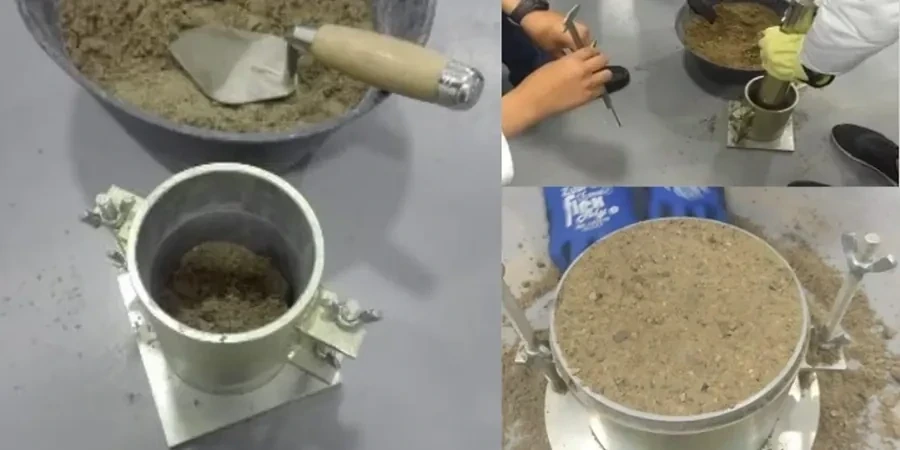
In-situ testing forms the backbone of geotechnical site investigation across Aylesbury, providing engineers with direct measurements of soil and material properties without disturbing their natural state. This category encompasses a range of field-based procedures that evaluate ground conditions, density, strength, permeability, and deformation characteristics right where they matter most—on site. For a town experiencing steady residential expansion and infrastructure upgrades, accurate in-situ data is essential to designing foundations that perform reliably in the long term.
Aylesbury’s underlying geology presents a varied profile that directly influences the choice and interpretation of in-situ tests. Much of the town sits on the Gault Clay and Upper Greensand formations, with pockets of glacial till and alluvial deposits along the River Thame floodplain. These clay-rich soils can be sensitive to moisture changes and exhibit shrink-swell behaviour, while the granular Greensand layers may pose challenges related to density and bearing capacity. Understanding these local conditions through direct field measurements allows engineers to tailor solutions rather than relying on conservative assumptions.
All in-situ testing carried out in Aylesbury must comply with the relevant British Standards, particularly BS 5930 for site investigation and BS 1377 for soil testing. These standards define the procedures, equipment calibration, and reporting requirements for methods ranging from penetration tests to density assessments. Adhering to these norms ensures that results are consistent, defensible, and suitable for submission to building control bodies or the NHBC. When a specific test such as the field density test (sand cone method) is employed, compliance with the prescribed methodology is critical for validating compaction levels in engineered fills.
The types of projects that routinely demand in-situ testing in Aylesbury span from small-scale housing plots to major commercial developments and highway schemes. Residential developers require density and bearing capacity data for foundation design, while infrastructure projects like the Aylesbury Link Road or flood alleviation works depend on permeability and strength profiling to ensure stability. Even refurbishment and extension projects on older properties can benefit from in-situ assessments, especially where historical fill or undocumented ground conditions are suspected. Each test, whether a dynamic probe or a sand cone density test, contributes a piece to the overall ground model.
In-situ testing assesses soil and rock properties directly in the ground without removing samples, preserving natural stress conditions, moisture content, and structure. It is preferred when sample disturbance could alter key parameters or when continuous profiling is needed. Methods like penetration tests and the sand cone density test provide immediate, representative data that complement laboratory analysis for a complete geotechnical picture.
Aylesbury’s Gault Clay and alluvial deposits require tests that capture moisture sensitivity and shrink-swell potential, such as in-situ density and strength profiling. Granular Greensand layers may need penetration testing to assess bearing capacity. The variable geology means a combination of tests is often specified to ensure foundations are designed for the specific ground conditions encountered on each site.
BS 5930 provides the overarching code of practice for ground investigation, detailing how in-situ tests should be planned and executed. BS 1377 covers specific soil testing methods, including density assessments. Additional standards like BS EN ISO 22476 for penetration tests may also apply, ensuring all fieldwork meets recognised quality and reporting benchmarks for regulatory approval.
A field density test is typically required to verify compaction of engineered fill beneath foundations, roads, or embankments. In Aylesbury, where clay backfill is common, achieving specified density is critical to prevent settlement. Building control or warranty providers such as NHBC often mandate such testing before construction proceeds, ensuring the placed material meets design specifications.