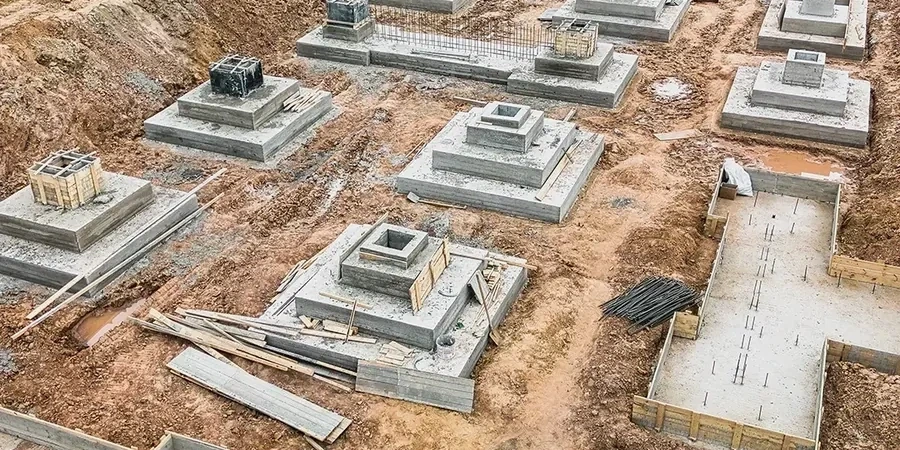
Working to Eurocode 7 (BS EN 1997-1:2004) isn't just a box-ticking exercise in Aylesbury—it's the foundation of every pile design we produce. The town sits squarely on the Kimmeridge Clay Formation, and anyone who's broken ground here knows it brings a specific set of geotechnical challenges: high plasticity, significant shrink-swell potential, and a water table that can shift dramatically between winter and spring. Our pile foundation design process starts with a forensic assessment of the ground investigation data, correlating local borehole logs with the British Geological Survey's regional mapping to pinpoint the depth to competent bearing strata. We've seen too many projects where a generic design assumption led to costly variations later, so we prefer to get it right the first time by integrating site-specific parameters into every calculation. When the upper clays show low undrained shear strength, we often specify deeper bored piles socketed into the more competent mudstone, and we validate the shaft friction assumptions using results from an in-situ permeability assessment to understand how groundwater flow might affect long-term skin friction.
In Aylesbury's Kimmeridge Clay, a well-designed pile isn't just a structural element—it's the only thing standing between your building and a decade of differential settlement.
Approach and scope
Aylesbury's expansion over the last two decades, particularly with the Berryfields and Kingsbrook developments, has transformed former agricultural land into dense residential zones. This rapid growth has pushed construction onto marginal ground where traditional shallow footings simply can't cope with the settlement predictions. Our pile foundation design methodology draws on lessons from these large-scale projects, where we observed that the weathered zone of the Kimmeridge Clay can extend down to 3 or 4 metres in some areas, creating a compressible crust that must be bypassed entirely. We model pile groups using finite element software to account for group effects and negative skin friction, especially where new fill has been placed over compressible natural soils. For projects near the Grand Union Canal or the River Thame, we also incorporate lateral load analysis from the adjacent infrastructure, frequently pairing our pile designs with
retaining-walls analysis to ensure the excavation support system and the permanent foundations work as a compatible unit rather than fighting each other.
Standard penetration test data from local investigations, interpreted through the lens of BS 5930:2015, often shows N-values climbing into the 30-plus range only once you're past 10 metres. That's why we don't guess on pile length—we back-calculate from the actual stratigraphy. To refine the shaft resistance parameters in the overconsolidated clays, we sometimes recommend supplementary
triaxial testing on undisturbed samples, which gives us the effective stress strength envelope needed for a realistic pile capacity prediction rather than relying solely on empirical correlations.
Local ground factors
Aylesbury sits at approximately 80 metres above sea level, and while it's not in the highest seismic hazard zone for the UK, the real risk here isn't earthquakes—it's volumetric movement from the clay. The shrink-swell behaviour of the Kimmeridge Clay is notorious, with seasonal moisture variations capable of generating heave pressures that can lift a lightly loaded slab or a short pile if the design doesn't account for it. We've reviewed existing foundation reports around the town centre where older buildings on shallow footings have cracked visibly due to differential movement, and the cost of underpinning after the fact far exceeds the investment in a proper pile foundation design from the start. Another underestimated risk in Aylesbury is the presence of historical clay pits and brickworks, now backfilled and built over. These made-ground deposits are highly variable and can mask the true depth to competent strata. Our pile designs for sites with suspected fill incorporate a solid verification programme because we know that a single uncharted soft pocket under a pile toe can shift the failure mode from ductile settlement to a brittle punch-through.
Q&A
How much does a pile foundation design for an Aylesbury project typically cost?
For a standard residential or small commercial development in Aylesbury, our pile foundation design fees generally range from £1,160 to £5,500, depending on the number of piles, the complexity of the ground conditions, and the level of testing required. A straightforward design for a single detached house on known ground will be at the lower end, while a multi-storey block requiring detailed group analysis and load testing specifications will be higher. We'll always give you a fixed-price proposal after reviewing your ground investigation data.
Why can't I just use trench fill foundations in Aylesbury?
Trench fill can work on some Aylesbury sites, but it's a gamble on the Kimmeridge Clay. If the clay's plasticity index is high and trees are nearby, the shrink-swell movements can easily exceed the tolerance of a shallow strip foundation. We often see ground investigation reports recommending a minimum foundation depth of 2.5 metres for trench fill, but on many plots, the competent bearing stratum is much deeper. Piles transfer the load past the active zone entirely, which removes the seasonal movement risk that's inherent to shallow solutions on this geology.
Do you handle the pile load testing as part of the design?
Yes, we specify the load test programme as an integral part of the pile foundation design, not as an afterthought. For projects in Aylesbury, we typically recommend a preliminary test pile programme if the ground variability is high, followed by working pile tests on at least 1 in 100 piles. We write the test specification, define the acceptance criteria based on our design loads, and can attend site during the testing to review the load-settlement curves in real time.
What's the difference between a CFA pile and a driven pile for Aylesbury's ground?
In Aylesbury's urban and suburban areas, Continuous Flight Auger (CFA) piles are usually preferred because they generate far less vibration and noise than driven piles, which is critical when you're building close to existing houses or on a tight infill plot. From a geotechnical perspective, CFA piles also work well in the stiff Kimmeridge Clay because the auger can cut through the weathered crust and socket into the competent mudstone without the refusal problems you might get with a driven pile hitting a hard band prematurely. We design both types, but CFA ends up being the practical choice for most Aylesbury projects.