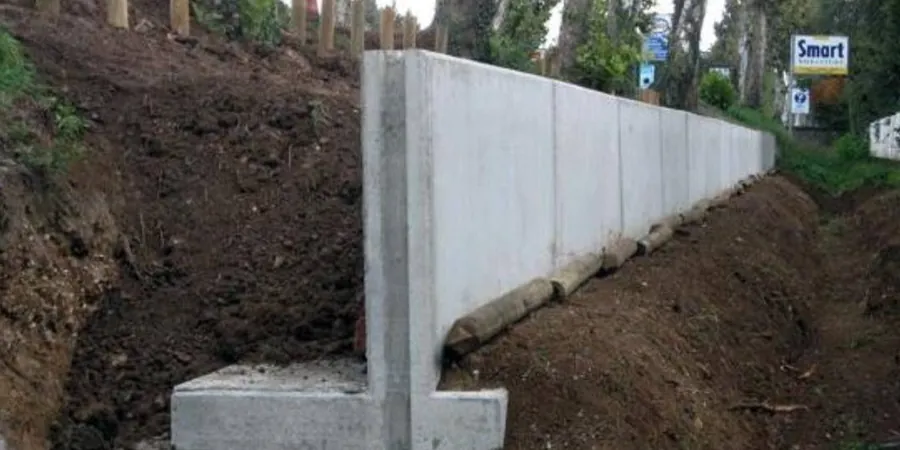
Aylesbury sits on a complex geological mix of Gault Clay, Kimmeridge Clay, and the Lower Chalk, where winter saturation can raise groundwater by over a metre in a matter of days. That shift in moisture content directly influences lateral earth pressures on any retaining structure, whether you are working on a residential cut in Bedgrove or a commercial basement near the town centre. The swelling potential of the local clays is something we factor into every retaining wall design from the outset, because a wall that looks fine in August can face a very different load case come February. We combine site-specific ground investigation with in-situ permeability data to understand drainage behaviour before selecting the wall type, and when the formation level sits on chalk we often run CPT testing to confirm rockhead depth and avoid surprises during excavation.
A retaining wall in Aylesbury clay must be designed for the soil's swelling pressure, not just its drained strength — otherwise winter groundwater will test every joint.
Local ground factors
When we mobilise a cable percussion rig on an Aylesbury site, the first metre or two of drilling through weathered Gault Clay often tells us more than any desk study can: the colour changes from grey-brown to dark grey, the moisture content jumps, and the recovery of intact samples becomes challenging. If drainage is not properly detailed behind the wall, pore water pressures build up during prolonged wet periods, reducing the effective stress and pushing the wall past its serviceability limit. We have seen garden retaining walls in the Fairford Leys area tilt outward within five years because the contractor backfilled with on-site clay instead of free-draining granular material. A solid retaining wall design in this town must include a drainage blanket, a filter separator to prevent fines migration, and weep holes spaced no more than 1.5 metres apart; omitting any one of these components turns a calculated design into a gamble on the weather.
Q&A
How much does retaining wall design cost for a typical Aylesbury project?
For a residential retaining wall in Aylesbury, the design fee typically falls between £900 and £3,220 depending on the retained height, whether ground investigation data already exists, and the complexity of the drainage detail. A taller wall requiring new boreholes and triaxial testing will sit at the upper end of that range.
What type of retaining wall suits the clay soils in Aylesbury?
Cantilever reinforced concrete walls are common for heights up to about 4 metres, but on Gault and Kimmeridge Clay the key decision is not the wall type so much as the drainage design. We specify free-draining granular backfill and weep holes as a minimum, and for taller structures we often recommend an embedded wall with passive resistance in the chalk below.
Do I need a ground investigation before retaining wall design?
Yes, and in Aylesbury it is particularly important because the clay properties can change within a few metres laterally. A desk study alone cannot confirm the plasticity, undrained shear strength, or groundwater level with enough certainty to satisfy BS EN 1997.
How long does the design process take?
Once ground investigation data is available, a typical retaining wall design for an Aylesbury residential project takes two to three weeks. This covers parameter selection, structural calculations, drainage detailing, and preparation of construction drawings.
Can you design a retaining wall next to a neighbour's property in Aylesbury?
Yes, and the Party Wall Act 1996 applies in England and Wales. We coordinate with the appointed party wall surveyor, and our design includes an assessment of the zone of influence to confirm that the excavation does not undermine the adjoining foundation.