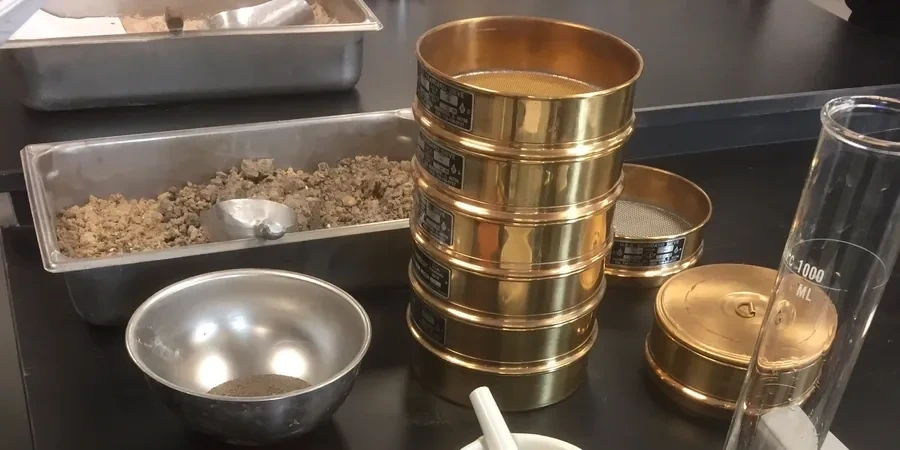
In Aylesbury, we often see preliminary site reports that miss the mark because they rely on sieve-only results. The problem is that much of the Vale of Aylesbury sits on Kimmeridge and Gault clays, or mixed alluvium from the River Thame, and a sieve alone tells you almost nothing about the silt and clay fraction that governs drainage and shrink-swell behaviour. For a town where 3,000 new homes are planned in the Garden Town expansion alone, getting the fines content wrong can cascade into costly foundation redesigns. We run the full combined particle size distribution—sieve stack plus sedimentation hydrometer—so the classification under BS 5930 is complete, not guessed. This dovetails naturally with atterberg limits when the clay fraction is significant, giving you the full plasticity picture rather than a fragmented dataset.
A sieve-only gradation on Gault clay can misclassify the material by two groups—the hydrometer is what catches the 40% silt fraction that governs seasonal volume change.
Approach and scope
The setup we mobilise to Aylesbury sites is straightforward but calibrated to UKAS-accredited standards. The sieve column runs from 63 mm down to 63 µm, using 200 mm and 300 mm diameter brass frames with stainless mesh, shaken on a Ro-Tap machine that keeps the amplitude constant across the full stack. For the sub-63 µm material, the hydrometer test uses a 151H or 152H buoyancy spindle in a temperature-controlled sedimentation cylinder, with readings logged at 0.5, 1, 2, 4, 8, 15, 30, 60, 120, and 1440 minutes per BS EN 1997-2. The dispersing agent is sodium hexametaphosphate at 40 g/L, and we correct for meniscus, temperature, and dispersant blank on every run. On mixed-face sites near the Chiltern scarp, where chalk brash sits over clay, the combined curve reveals bimodal gradations that a simple sand-gravel split would hide. For coarser material we often pair this with
in-situ permeability testing, because grain size alone doesn't always predict field drainage rates in layered fluvial deposits.
Local ground factors
BS EN 1997-2 §4.3.1 requires that soil description be based on both grading and plasticity for fine soils, and that’s where corners get cut in Aylesbury. The town’s geology transitions rapidly: alluvial silts near the Thame floodplain, Gault clay across the western parishes, and chalk marl rising toward Wendover. A grading curve that stops at 63 µm classifies a clayey SILT as a silty SAND if the fines percentage isn’t quantified, and that misclassification feeds directly into bearing capacity and serviceability limit state checks. The hydrometer step is what catches the 20–50% silt fraction typical of Head deposits on the lower slopes of the Chilterns. Without it, you’re designing retaining structures on assumed parameters that may be two soil groups off. On Garden Town infrastructure schemes, we’ve seen tender-stage savings evaporate when the contractor discovers the real ground isn’t what the desk study implied—and it almost always traces back to incomplete particle size data.
Q&A
How much does a combined grain size analysis cost in Aylesbury?
A combined sieve and hydrometer test on a single sample typically runs between £90 and £170, depending on the number of size fractions and whether the material needs pre-treatment for organic content or carbonates. Larger site investigation programs with batch pricing usually come in at the lower end.
Why is the hydrometer test necessary for Aylesbury clay sites?
Because the Gault and Kimmeridge clays that underlie much of Aylesbury contain 30–60% silt, and a sieve alone stops at 63 µm—completely missing the silt fraction. Without the hydrometer sedimentation curve, you cannot determine the clay/silt split, which controls Atterberg limits, shrink-swell potential, and the drained/undrained design parameters for foundations.
How long does the lab take to return results?
Standard turnaround is three working days from sample receipt. The hydrometer sedimentation run itself takes a minimum of 24 hours because readings must be taken at logarithmically spaced intervals. Expedited two-day reporting is available for an additional fee when the programme is tight.