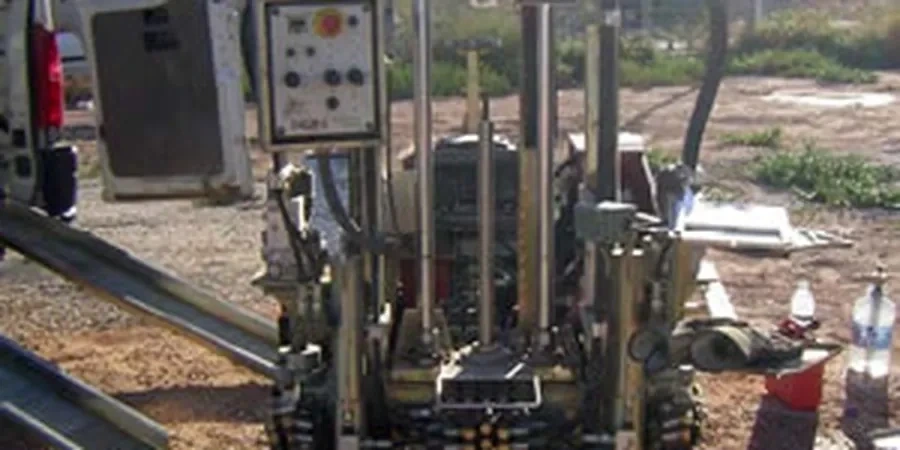
BS EN 1997-2:2007 mandates adequate ground investigation for all structures, and in Aylesbury this requirement takes on particular significance. The town sits on the complex Quaternary deposits of the Vale of Aylesbury, where the Gault Clay and Lower Greensand formations create a layered subsurface that can vary dramatically over short distances. A standard borehole alone often misses critical thin layers. Our CPT testing programme in Aylesbury uses a 20-tonne penetrometer to push an instrumented cone at a constant 20 mm/s, recording cone resistance (qc), sleeve friction (fs), and dynamic pore pressure (u2) at 10 mm intervals. This continuous profile is essential for detecting the soft clay lenses and sand stringers common in the area. For projects near the River Thame, we often combine CPT data with in-situ permeability testing to assess drainage conditions before footing design.
A single CPT sounding in Aylesbury clay delivers a continuous 20-metre stratigraphic log with five independent measurements every centimetre—no other investigation method provides this resolution.
Local ground factors
A recurring mistake we see on Aylesbury sites is relying solely on SPT data from cable tool boring through the Gault Clay. The SPT blow count (N) provides a single data point every 1.5 metres and completely misses the thin silt partings that control drainage and stability. We have reviewed several cases where a 200 mm silt seam at 4 m depth, invisible to SPT, caused a temporary works slope failure during excavation for a basement near the town centre. CPT detects these seams instantly through the pore pressure response. Another common error is misclassifying the Lower Greensand as a dense granular unit without checking the friction ratio, when in fact it can contain clay-bound sands that behave as intermediate soils. Our CPT interpretation uses the Robertson (1990) soil behaviour type charts, calibrated against local sampling, to avoid these classification pitfalls. For excavations in the historic core of Aylesbury, we also correlate CPT data with slope stability analysis to verify temporary batter angles.
Q&A
What depth can a CPT rig reach in Aylesbury ground conditions?
Our standard 20-tonne CPT rig typically reaches 20 to 25 metres in the Aylesbury area, depending on the density of the Lower Greensand. In the stiff Kimmeridge Clay we routinely achieve 20 metres without refusal. Where the Greensand is particularly dense or contains cobbles, penetration may stop earlier, and we would then recommend supplementary borehole investigation.
How long does a single CPT sounding take on site?
A single 20-metre CPTu sounding with three dissipation tests takes approximately 1.5 to 2 hours on an Aylesbury site, including rig setup and breakdown. SCPTu soundings require an additional 30 minutes for the seismic testing. Mobilisation to Aylesbury from our nearest depot is typically same-day for planned investigations.
What is the typical cost range for CPT testing in Aylesbury?
CPT testing in Aylesbury typically ranges from £150 to £220 per sounding metre, depending on the number of soundings, access constraints, and whether piezocone or seismic cone is required. A mobilisation charge applies for single-day investigations. A detailed quote is provided after reviewing the site location and proposed depth.
Can CPT replace boreholes for a foundation design in Aylesbury?
CPT provides continuous data that is superior to SPT for stratigraphic profiling and parameter derivation, but for most Aylesbury projects we recommend a combined approach. CPT cannot recover samples for laboratory classification or triaxial testing. A typical investigation might use CPT soundings to define the stratigraphy and identify critical layers, supplemented by one or two boreholes at key locations to recover samples for Atterberg limits and strength testing.