← Home · Laboratory

Proctor Compaction Testing in Aylesbury: Standard and Modified Methods

Together, we solve the challenges of tomorrow.

DETAILS →

When the site strip exposed a stiff grey Gault Clay over chalk marl on the Bierton Road development, the earthworks contractor needed a reliable moisture-density relationship before placing the engineered fill. Our lab received the bulk samples that same afternoon and started the Proctor test the following morning. In Aylesbury, with its mix of heavy clays and dry chalky drift, knowing whether to apply the standard 2.5 kg rammer method or the modified 4.5 kg procedure can change the entire compaction specification. We run both the BS 1377-4 and BS EN 13286-2 protocols, because the local geology rarely fits a single textbook profile. The bench test alone defines the target dry density and optimum moisture content that the sand cone density crews use later on site, and it often reveals whether the borrow pit material will even work without blending. For projects where the formation is particularly variable, we also coordinate with test pits to get representative samples from different horizons.

A single Proctor curve plotted from five points can change the fill specification and save weeks of re-rolling on site.

Approach and scope

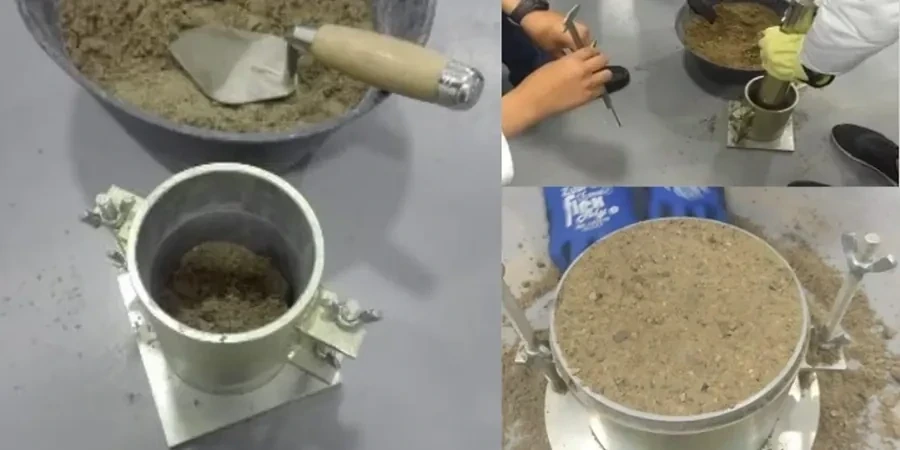
One thing we notice repeatedly with Aylesbury materials is how sensitive the compaction curve becomes when the clay fraction sits between 18 and 25 percent, a range common in the head deposits mantling the Chiltern dip slope. The standard Proctor test applies a 2.5 kg rammer dropped 300 mm in three layers, each receiving 27 blows, while the modified version uses a 4.5 kg rammer dropped 450 mm in five layers with the same blow count. The extra compactive effort often pushes the maximum dry density up by 7 to 12 percent and drops the optimum moisture content by 2 to 4 percentage points, which matters enormously when the specification calls for 95 percent relative compaction. Our technicians run the material through a 20 mm sieve first, record the oversize correction when gravel exceeds 5 percent, and plot the full curve from at least five points. Because much of the fill used locally is chalky till or reworked Kimmeridge Clay from borrow pits near Thame, the shape of the curve tells us straight away whether the material will be moisture-sensitive during rolling. We complement these results with Atterberg limits when the plasticity affects the air voids calculation, and with grain size analysis to confirm the fines content that drives the compaction behaviour.
Proctor Compaction Testing in Aylesbury: Standard and Modified Methods
Technical reference image — Aylesbury

Site-specific factors

Aylesbury sits at roughly 80 metres above ordnance datum on the Vale floor, where the winter groundwater can rise to within 600 mm of the surface in the alluvial pockets along Bear Brook. The compaction specification that worked in August on a dry chalk fill can fail completely in November when the same stockpile soaks up rainwater and the moisture content drifts 3 percent above optimum. We have seen site density tests come back at 89 percent relative compaction on a heavily over-consolidated Gault Clay fill simply because the Proctor reference was run on air-dried material that did not represent the wet placement condition. The real risk is not just low density but the delayed settlement that appears six months after the pavement is laid, when the clay matrix re-equilibrates and loses volume. Running the Proctor test at the as-received moisture and on fully soaked samples gives the designer a sensitivity envelope that makes the difference between a stable platform and a soft spot under the binder course.

Need a geotechnical assessment?

Reply within 24h.

Email: contact@geotechnical-engineering1.com

Technical parameters


ParameterTypical value
Standard Proctor rammer mass2.5 kg
Modified Proctor rammer mass4.5 kg
Drop height (standard / modified)300 mm / 450 mm
Number of layers (standard / modified)3 / 5
Blows per layer27
Mould internal diameter105 mm (1-litre mould)
Oversize correction threshold>5% retained on 20 mm sieve
Typical max dry density range (Aylesbury Gault Clay)1.72–1.88 Mg/m³ (standard)

Related technical services

01

Standard Proctor (2.5 kg)

BS 1377-4 method using the light rammer in a 1-litre mould, typically specified for landscaping, trench backfill, and low-height embankments where the plant compactive effort is moderate.

02

Modified Proctor (4.5 kg)

BS 1377-4 heavy rammer method, applied to road sub-base, structural fill under footings, and engineered platforms where the specification demands higher target density and tighter moisture control.

03

Moisture-conditioning and re-testing

We condition samples at target moisture contents, run the full five-point curve, and report the optimum moisture content and maximum dry density with the oversize correction applied in accordance with BS 1377.

Relevant standards


BS 1377-4:1990 – Compaction-related tests, BS EN 13286-2:2010 – Unbound mixtures, Proctor compaction, Eurocode 7 (BS EN 1997-2:2007) – Ground investigation for earthworks design

Q&A

How much does a Proctor test cost in Aylesbury?

For a single-point or full five-curve standard Proctor test, prices typically run from £70 to £180 depending on whether you need the standard or modified method, the number of points on the curve, and if oversize correction is required. We provide a firm quote once we know the material type and the project specification.

Which Proctor method is right for my Aylesbury site?

It depends on the specification. For structural fill under foundations or road sub-base, the modified Proctor (4.5 kg rammer) is the norm. For landscaping fill, trench reinstatement, and low-level embankments, the standard method (2.5 kg rammer) is usually sufficient. We can advise once we see the engineer's compaction requirements.

Why does the same soil give different optimum moisture content with the two methods?

The modified Proctor applies roughly four times the compactive energy per unit volume compared with the standard method. That extra energy rearranges the clay particles more efficiently, so the peak of the compaction curve shifts to a higher dry density and a lower moisture content. It is a physical response of the soil fabric, not a testing error.

How quickly can I get results for a Proctor test from your lab?

Once we receive the bulk sample, we can usually turn around a standard Proctor curve within three working days. If the project is on a tight programme, we can prioritise the test and report the curve and the 95-percent relative compaction target density sooner, provided the material does not require extended moisture conditioning.
Location and service area

We serve projects across Aylesbury and its metropolitan area.

View larger map