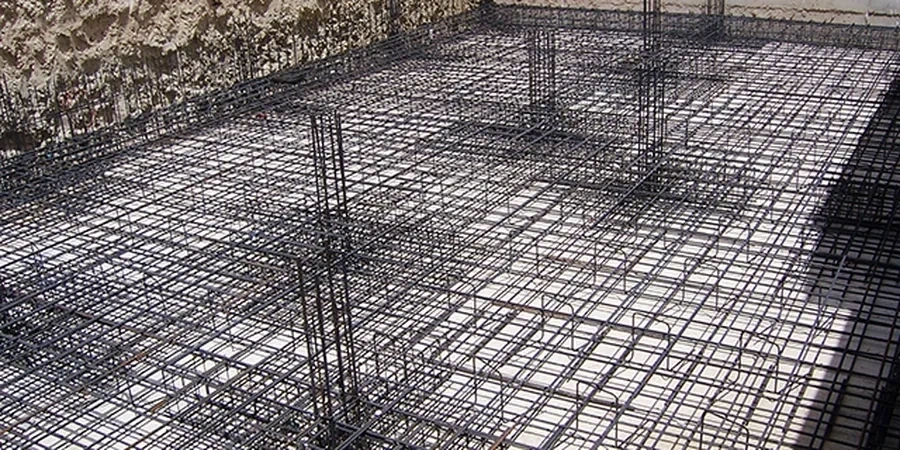
The ground beneath Aylesbury changes fast. One site near the town centre sits on firm Gault Clay that holds a load with little settlement. Half a mile east, toward Bierton, the Kimmeridge Clay softens and the water table rises within two metres of the surface. That difference changes everything when you design a foundation slab. A raft/mat foundation design bridges the gap. Instead of guessing, we run lab tests on samples pulled from your borehole or trial pit and feed real strength and compressibility numbers into the model. The output is a slab thickness, reinforcement layout, and bearing pressure check that works for the exact geology under your building. For sites where the clay gets deep, we often run triaxial tests to define the undrained shear strength profile before the raft geometry is set.
A raft foundation distributes building load over the full footprint. On Aylesbury's mixed clays, that reduces differential settlement by up to 40% compared with isolated footings.
Site-specific factors
The most common mistake on Aylesbury sites? Treating the whole plot as having uniform ground. A contractor digs a trial pit at one corner, sees stiff clay, and assumes the rest of the site is the same. Then the raft gets poured at a uniform thickness, and six months later the corner over the old stream channel settles 25 mm. Cracks appear in the blockwork, and the repair costs dwarf the original ground investigation budget. A proper raft/mat foundation design requires at least three points of ground data. We test each sample separately, map the variability, and give the engineer a zoned subgrade reaction model. With that input, the slab can be stepped, thickened locally, or reinforced differently where the ground softens. The alternative is a slab that works on paper but fails in the ground.
Q&A
How much does a raft/mat foundation design cost for a typical project in Aylesbury?
For a standard residential or light commercial project, the ground investigation, lab testing, and design typically range from £920 to £3,210. The final figure depends on the number of boreholes, the lab test schedule, and whether we need to model complex ground variability.
When is a raft foundation better than strip footings on Aylesbury clay?
A raft works well when the near-surface clay has low bearing capacity (Cu below 50 kPa) or when the ground is variable across the footprint. It bridges soft spots, reduces differential settlement, and avoids deep excavation into water-bearing layers that are common east of the Thame.
What lab tests do you run to get the modulus of subgrade reaction?
We use oedometer consolidation tests on undisturbed samples to derive the coefficient of volume compressibility (mv) and constrained modulus, then back-calculate ks. Where granular soils are present, we correlate ks with SPT N-values or use plate load test data if available.
Do you handle the structural design of the raft or just the geotechnical parameters?
Our scope covers the geotechnical input: bearing capacity, settlement estimates, and subgrade reaction values. The structural design of the slab reinforcement, thickness, and concrete specification is typically done by the project structural engineer. We work directly with them to ensure the ground model is correctly applied.