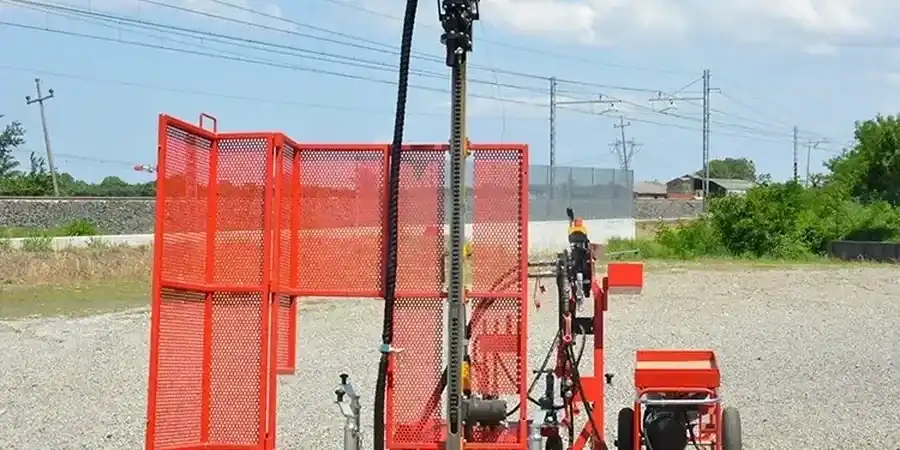
The automatic trip hammer on a cable percussion rig delivers a consistent 76 cm free-fall onto the drive head. That mechanical rhythm is the heartbeat of every Standard Penetration Test we execute in Aylesbury. With a split-spoon sampler pushed 150 mm to seat, then driven over 300 mm of penetration, the recorded N-value starts to paint a picture of the Jurassic clays and Cretaceous sands that underlie this part of Buckinghamshire. The town sits on a geological boundary where Gault Formation clays transition into the chalky till of the Vale of Aylesbury, and getting clean SPT data means managing groundwater ingress that often appears at just 2 to 3 metres depth. For foundation designers working on the Berryfields expansion or the Woodlands redevelopment, the blow count per 300 mm is not just a number—it is the direct empirical basis for selecting bearing capacity and settlement parameters under Eurocode 7. When the upper weathered crust masks the competent stratum, we often pair SPT logging with a CPT test to capture continuous tip resistance profiles through the transition zone without losing the soil sample for visual classification.
An SPT N-value in Aylesbury Gault Clay typically ranges from 8 to 22 blows, but a single weathered horizon can halve that number in less than a metre—sampling interval matters more than the rig.
Approach and scope
The Vale of Aylesbury experiences a marked seasonal swing: winter saturation pushes the Gault Clay toward a high-plasticity state, while dry summers can shrink the upper metre into a stiff, fissured crust. This contrast directly influences SPT energy transfer because the rod friction component changes with soil moisture. Our field crews compensate by recording torque on the rods every 3 m and by applying the BS EN ISO 22476-3 correction for energy ratio using instrumented hammer data. In the town centre, where the Kellaways Sand Member appears beneath alluvial gravels, SPT refusal above 50 blows for 300 mm is common once the sampler hits dense, cemented bands. The real value for the project engineer comes when we correlate SPT N60 values with undrained shear strength in clay using the Stroud relationship, and then feed that into bearing capacity calculations for shallow footings. On commercial jobs near the Aylesbury Vale Parkway, we have used SPT-derived relative density to calibrate Improvement targets before vibrocompaction, saving the client unnecessary over-treatment.
Local ground factors
The contrast between the old town core and the southern expansion zones is a textbook example of Aylesbury's variable ground risk. Around St Mary's Church, shallow foundations encounter stiff, overconsolidated Gault Clay with SPT N-values above 25—competent but sensitive to moisture-driven volume change. Move south toward the newer estates near the River Thame floodplain, and the profile shifts to soft alluvial silts where N-values of 3 to 6 are not unusual in the top 4 metres. Skipping SPT investigation in these transition zones leaves the structural engineer guessing whether differential settlement will appear between the stiff clay and the compressible alluvium beneath the same building footprint. We have seen sites where two boreholes spaced 15 m apart returned N60 values that differed by a factor of three, purely because one hit a buried channel infill. The cost of a single SPT borehole is trivial compared with the expense of underpinning a settled structure later, and in a market town where many commercial buildings date from the Victorian era, the soil memory often includes unrecorded fill or old pond linings that only a split-spoon sample can reveal.
Q&A
How much does an SPT investigation cost for a typical residential plot in Aylesbury?
For a single-family home plot in Aylesbury, an SPT investigation with two boreholes to 10 m depth typically falls between £390 and £660 per borehole, depending on access conditions and whether laboratory testing is included. Sites with difficult access or deeper refusal in chalk may push toward the upper end.
What depth do you need to reach for SPT testing in Aylesbury's geology?
We usually target a minimum depth of 8 m to 10 m for residential foundations, but the exact depth depends on the site location relative to the chalk bedrock. In the town centre the chalk can be encountered at 5 m, while in the floodplain south of Aylesbury the alluvial sequence may extend beyond 12 m before competent material is reached.
Can SPT data from Aylesbury be used directly for pile design?
Yes, SPT N-values provide empirical input for pile design methods such as those in the ICE Manual of Geotechnical Engineering. For driven piles in the chalky till of Aylesbury, we correlate N60 with shaft friction and end-bearing capacity, though we always recommend supplementing with CPT data when pile loads exceed 500 kN.